







Aviation keyword research is the process of identifying how potential customers search for aviation services, information, aircraft, training, capabilities and solutions, then turning those search patterns into a website structure. Its value is not the size of the keyword list. Its value is deciding which searches deserve commercial pages, supporting content or no dedicated page at all.
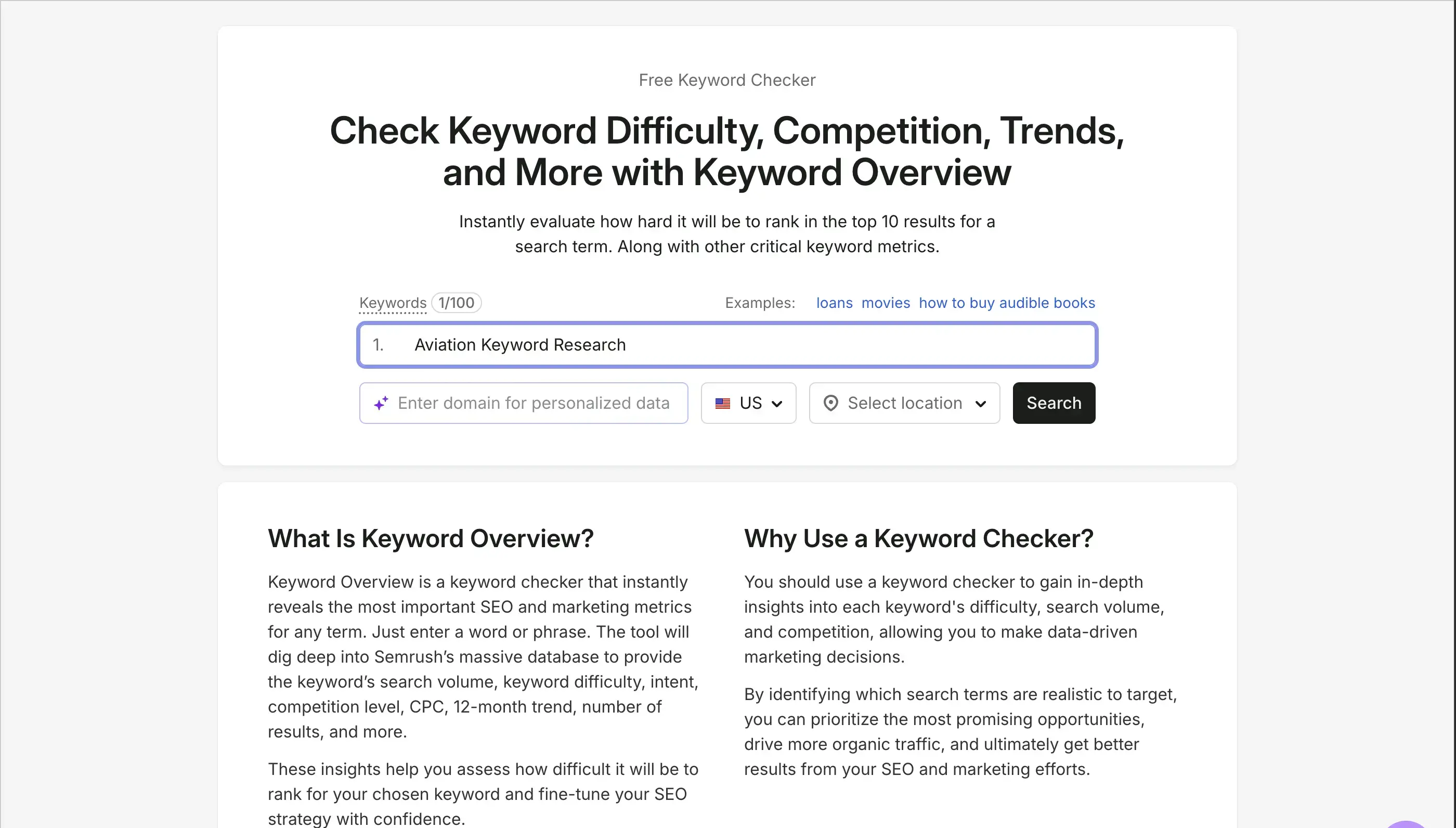
For airlines, flight schools, charter operators, aircraft brokers, MRO companies, airports and other aviation businesses, keyword research should therefore happen before large-scale content production. A search-led architecture gives each important topic a clear page owner and reduces the risk of several pages competing for the same intent.
What is aviation keyword research?
Aviation keyword research identifies the language people use when looking for aviation businesses, services and information, then groups those searches according to meaning and intent. The result should be a page map, not simply a spreadsheet of keywords.
The distinction matters because aviation businesses often have complex service structures. A single company may operate several aircraft types, serve different customer groups, offer multiple commercial services and work across several locations or regulatory environments. Search demand can therefore appear around the service itself, the aircraft, the location, the customer problem, a comparison or a specific operational question.
A strong Aviation SEO strategy connects those searches to the correct page type. Broad commercial queries normally belong to core service pages. More specific research questions may belong to supporting articles. Aircraft, training programs, capabilities or destinations may require their own structured pages when they represent distinct user needs.
A useful keyword map does not ask how many pages can be created from a keyword list. It asks how few clear, useful pages are needed to satisfy the distinct search intents that matter to the business.
Start with aviation entities and business reality before using keyword tools
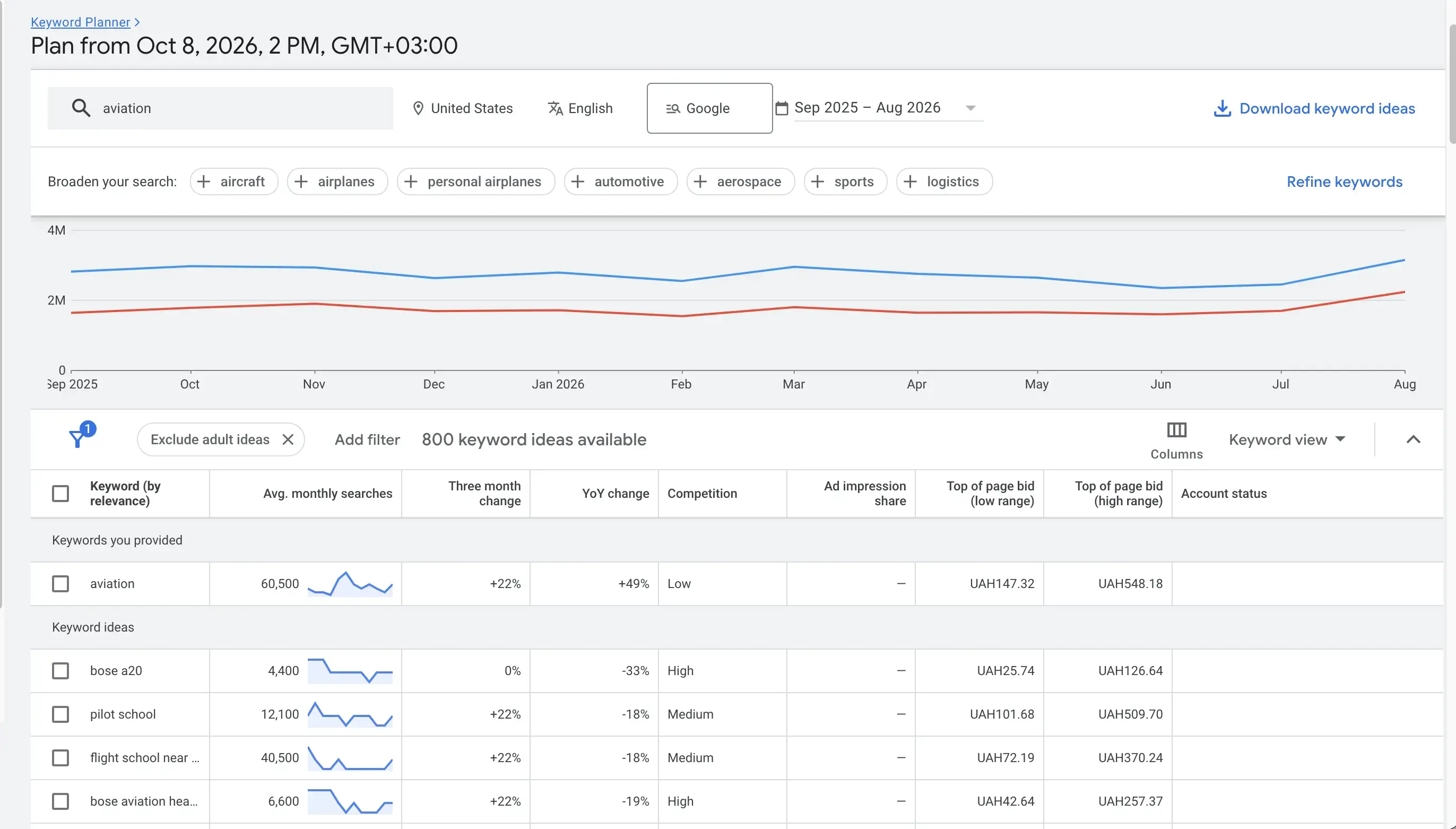
The first source of keyword ideas should be the business itself. Before opening a keyword tool, document the things customers can actually buy, compare, visit, operate or ask about.
Depending on the aviation sector, the initial entity list may include:
- services and service categories;
- aircraft manufacturers, families, models or fleet categories;
- training courses, licenses, ratings or programs;
- maintenance capabilities and supported aircraft;
- airports, bases, destinations or operating regions;
- aircraft listings and sales categories;
- passenger, cargo, charter, ACMI or other operating divisions;
- customer types and industries served;
- facilities, equipment or operational resources;
- questions that repeatedly appear during sales or enquiry conversations.
This creates a vocabulary grounded in what the company genuinely offers. Keyword tools can then expand those concepts rather than determining the strategy from scratch.
For example, a flight school should not begin with a generic list of aviation terms. It should first document its actual training programs, aircraft, student pathways, entry requirements, locations and frequently asked questions. An MRO should begin with its real capabilities, facilities, aircraft types and customer requirements. An aircraft broker should begin with aircraft categories, listing attributes, buyer questions and sales services.
Separate aviation keywords by search intent
Search intent describes what the user is trying to accomplish. Two keywords can contain similar words while requiring completely different pages because the person behind the search is at a different stage of the decision process.
| Intent | Typical aviation search behaviour | Likely page type |
|---|---|---|
| Informational | Learning how something works, what is required or how options differ | Guide, article, FAQ or educational resource |
| Commercial research | Evaluating providers, aircraft, programs, capabilities or solutions | Service page, comparison page, sector page or detailed guide |
| Transactional | Looking to request a quote, book, apply, buy or contact a provider | Money page, product or service page, listing or conversion page |
| Navigational | Trying to reach a particular company, portal, airport or known resource | Existing branded or utility page |
Intent should be judged from the likely task behind the search, not only from a keyword tool label. “Aircraft maintenance” may represent broad research, while a more specific capability query may indicate that the user already knows what service is required. A prospective student searching for general pilot career information is at a different stage from someone researching a specific training program offered by a school.
The page should match that stage. Trying to make one service page answer every informational question usually makes the page unfocused, while turning every keyword variation into a new blog post can create unnecessary duplication.
Build the aviation keyword universe in layers
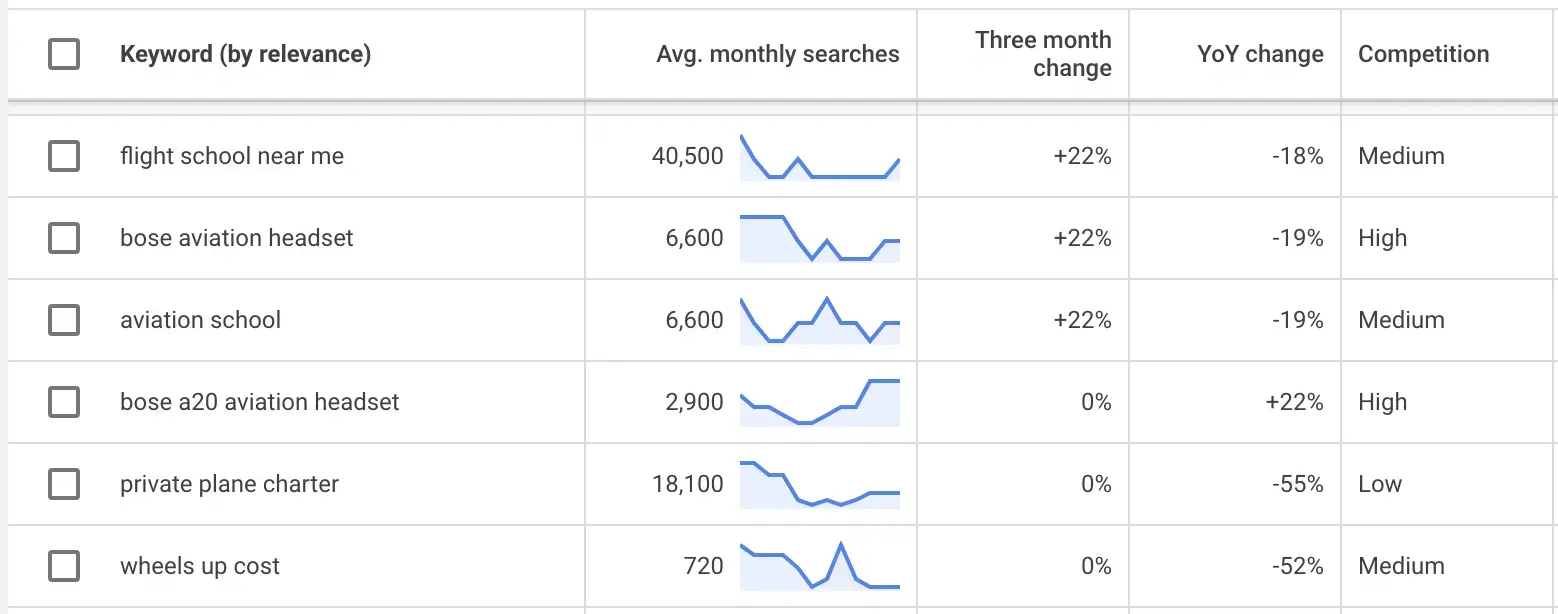
Once the business entities and major intents are clear, expand the keyword set systematically. A layered approach is more useful than collecting hundreds of unrelated phrases.
Core service keywords
Start with the services that directly represent commercial offers. Examples could include aircraft charter, flight training, aircraft sales, maintenance services, airport services or aviation website services. These clusters typically influence the site's main commercial architecture.
Service plus aviation entity
Users may narrow a search by aircraft category, aircraft model, training type, maintenance capability or another relevant entity. These combinations can reveal whether a broad service page needs supporting detail pages.
Problem and question keywords
Customer questions often produce strong supporting content because they reflect uncertainty that must be resolved before an enquiry. Examples include questions about selecting an aircraft, comparing training paths, understanding maintenance scope or preparing information for a charter request.
Comparison and evaluation keywords
Searches containing concepts such as alternatives, differences, costs, requirements or best-fit options often indicate commercial research. They can be valuable because the user is no longer simply learning a definition; they are evaluating a decision.
Location and destination modifiers
Location can be fundamental for some aviation businesses and irrelevant for others. Airports, charter operations, flight schools and local aviation services may have legitimate geographical intent. A global aviation supplier should not create location pages merely because a keyword tool shows combinations with city names.
Jurisdiction-specific terminology
Aviation terminology can vary by jurisdiction. Regulatory names, license terminology and operating categories should therefore be researched separately when the business serves markets governed by different authorities. The website should clearly identify the relevant jurisdiction rather than combining incompatible terminology on one page.
Cluster keywords by meaning before assigning URLs
Keyword clustering means grouping searches that can be satisfied by the same useful page. The goal is not to group phrases simply because they share words. The key question is whether the user would reasonably expect the same page to answer each query.
Consider a simplified flight school example. Queries around a specific training program, its requirements, duration and curriculum may belong to one strong program page. A broader question comparing two training pathways may deserve a supporting article because the intent is educational rather than directly transactional.
The same principle applies to other sectors:
- A charter operator may group aircraft-specific charter queries under individual fleet pages when the aircraft itself affects the buying decision.
- An MRO may separate capability pages when customers search for distinct maintenance services or supported aircraft.
- An aircraft broker may map model-specific sales intent to aircraft listings or category pages rather than generic articles.
- An airline may separate passenger, cargo, charter and ACMI sections when the audiences and commercial objectives differ substantially.
Specialist sector architecture can therefore look very different. An airline website may require routes, destinations and operating divisions, while a flight school website may organize around training programs, fleet, admissions and student decision questions.
Turn keyword clusters into a search-led website architecture
After clustering, assign each group to a page type and decide how pages relate to one another. This is where keyword research becomes information architecture.
| Keyword cluster | Recommended owner | Role in the architecture |
|---|---|---|
| Broad commercial service | Core service or sector page | Own the main transactional or commercial intent |
| Specific service or capability | Dedicated subservice page | Explain a distinct offer in greater depth |
| Aircraft, course or listing intent | Structured entity page | Provide specific facts and conversion context |
| Research question | Supporting article | Answer an informational need and link toward the relevant commercial page |
| Comparison intent | Guide or comparison resource | Help the user evaluate options |
| Location-specific intent | Location page when genuinely supported | Match a real geographical service or operational presence |
A useful architecture generally has clear parent-child relationships. A commercial page owns the core service topic. Supporting pages answer narrower questions, comparisons and problems, then link contextually back to that commercial owner.
This structure also gives aviation web development clearer requirements. Developers can create repeatable templates for aircraft, programs, capabilities, locations or listings once SEO planning has established which entities actually need dedicated URLs.
Protect commercial pages from keyword cannibalization
Keyword cannibalization occurs when multiple pages compete for substantially the same search intent. The problem is not that two pages happen to use the same word. The problem is that the website has not made it clear which page should satisfy the query.
Before creating a new page, check:
- Does an existing page already target this intent?
- Would the proposed page answer a genuinely different question?
- Is the new keyword simply a wording variation of an existing cluster?
- Should additional information be added to the current page instead?
- Would the new page strengthen or compete with the parent commercial page?
For example, if an aviation company already has a strong commercial page targeting its primary service, an article should not reproduce that page with a slightly different title. Supporting content should solve a narrower problem: selection criteria, process, costs, comparisons, preparation, technical considerations or another research-stage need.
This distinction is particularly important when building topical authority. Publishing more pages does not automatically create a stronger topic cluster. A smaller set of clearly differentiated pages can communicate the site structure more effectively than numerous overlapping articles.
Use internal links to communicate page relationships
Internal linking should reflect the keyword architecture. A supporting article should not exist as an isolated traffic destination; it should help a reader continue toward the relevant service, entity or next-stage resource.
Useful internal-link relationships include:
- supporting article → parent commercial page;
- commercial page → important subservices or entities;
- aircraft category → individual aircraft pages;
- training overview → individual course pages;
- capability overview → specific MRO capability pages;
- related supporting article → related supporting article when the next question is genuinely useful.
Anchor text should describe the destination naturally. Repeating an identical exact-match keyword every time is unnecessary. The surrounding sentence and page relationship provide context as well.
Navigation, breadcrumbs, related-content modules and contextual body links can all reinforce hierarchy, but they should not be used mechanically. The strongest links are those that help the user move to the logical next piece of information.
Do not let search volume decide the architecture alone
Search volume can help prioritize research, but it should not determine whether a page deserves to exist. Aviation markets often include specialized services where the most commercially relevant searches are narrower than broad consumer topics.
Evaluate a cluster using several questions:
- Business relevance: Does the company actually provide the service or information represented by the query?
- Intent: Is the searcher researching, comparing or preparing to take action?
- Distinctness: Does the query require a page different from one already planned?
- Ability to answer: Can the business provide useful first-hand or operationally accurate information?
- Conversion relationship: Is there a logical next step from this search to a commercial objective?
- Strategic importance: Does the topic strengthen an important service, capability or market even if raw volume appears limited?
A large-volume keyword with weak relevance can attract the wrong audience. A narrower query closely connected to a service may be more useful to the business. Keyword prioritization should therefore combine search data with commercial context.
Plan multilingual keyword research separately for each language
Multilingual SEO should not be based on translating an English keyword spreadsheet word for word. Search vocabulary, modifiers and preferred terminology can differ between languages even when the underlying service is identical.
For each language, validate:
- how the service is commonly described;
- whether English aviation terminology is retained or translated;
- which synonyms people actually search;
- whether search intent differs;
- which geographic modifiers are relevant;
- whether the same page architecture still makes sense.
The business architecture may remain consistent while the keyword targeting changes. For example, the same aircraft service can have equivalent pages across languages without forcing every translated page to target a literal translation of the English primary keyword.
This is another reason to separate the site's content model from its keyword wording. Services, aircraft and capabilities are stable entities; keyword research determines how those entities should be described and discovered in each market.
Validate the keyword map after the website starts receiving search data
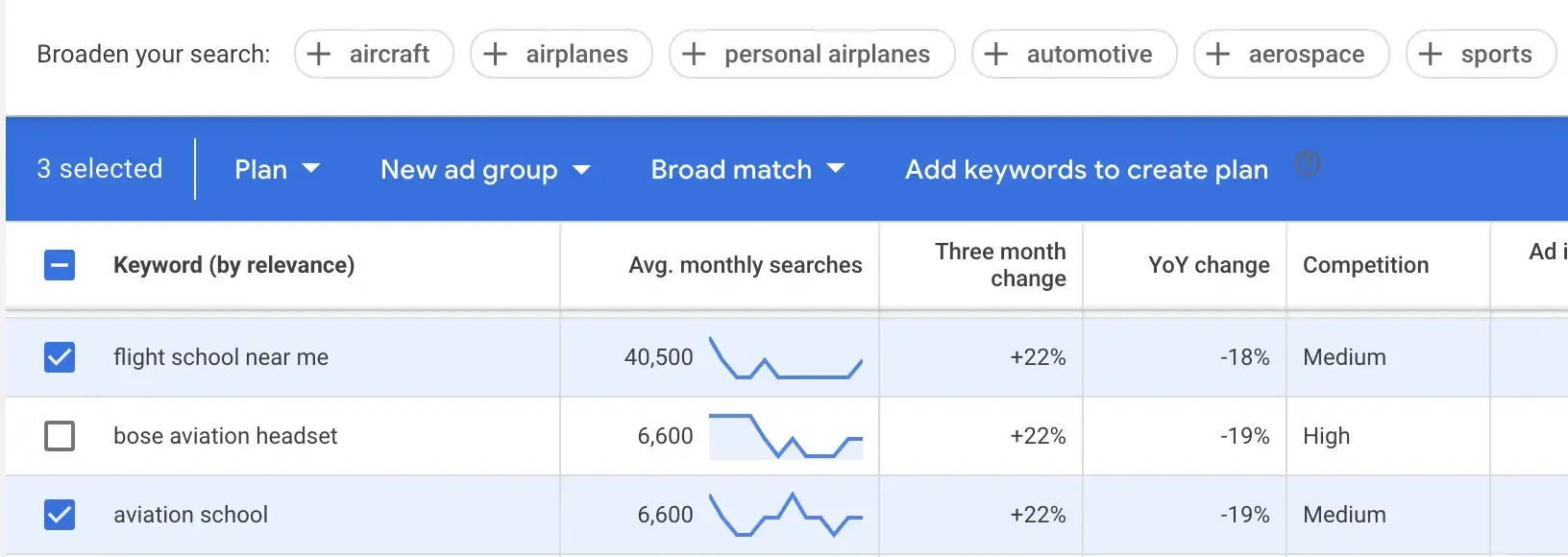
A keyword map is a planning model, not a permanent truth. Once pages are indexed and receiving impressions, real search data should be used to refine assumptions.
Google Search Console can reveal which queries Google associates with each page, whether several URLs are appearing for similar searches and which unexpected long-tail queries are gaining impressions. That information can indicate opportunities to improve a page, create genuinely new supporting content or consolidate overlapping pages.
Review search performance together with business outcomes. A page attracting impressions but no qualified actions may need a better search-intent match, stronger content, a clearer conversion path or a different priority within the strategy.
A useful review process is:
- compare actual queries with the original target cluster;
- check whether the intended page is appearing for the query;
- identify multiple pages competing for the same intent;
- review pages gaining unexpected but relevant impressions;
- compare organic landing pages with enquiry or conversion data;
- update content, internal links or page ownership where the evidence supports it.
This closes the loop between research and real user behaviour. Keyword research creates the first architecture; search data helps improve it over time.
Common aviation keyword research mistakes
- Starting with tools instead of services. The keyword list grows without reflecting what the aviation business actually sells.
- Choosing keywords only by volume. Commercial relevance and search intent are ignored.
- Creating one page for every keyword. Closely related variations produce thin, overlapping pages.
- Targeting every keyword on the homepage. Important services never receive clear page ownership.
- Mixing informational and transactional intent. Blog articles begin competing with money pages.
- Ignoring aviation entities. Aircraft, courses, capabilities and locations are treated as ordinary text rather than potential parts of the architecture.
- Translating keyword lists literally. Multilingual search behaviour is assumed to mirror English.
- Never revisiting the map. Real Search Console queries and lead data are ignored after publication.
A better process treats the keyword spreadsheet as a decision framework connecting search behaviour, page purpose and business value.
Frequently asked questions
Practical questions about researching aviation keywords and turning them into a website architecture.
01 How many keywords should one aviation page target? +
02 Should every aviation keyword have its own landing page? +
03 Should high-volume keywords always be prioritized first? +
04 How do I know whether two aviation keywords belong on the same page? +
05 When should an aviation keyword map be updated? +
Final thoughts
Aviation keyword research is most valuable when it changes the structure of the website before it changes the wording of individual pages. Start with real services and aviation entities, classify search intent, group related queries and assign each meaningful cluster to one clear page owner.
The result should be a site where commercial pages, entity pages and supporting content have distinct jobs. That clarity helps users move through the research process, gives search engines stronger page relationships and creates a more scalable foundation for future aviation content.
Need help with your aviation website?
Turn your website into a clearer, faster and more visible digital system built around your aviation business goals.